
2025 Recap: Five Key Developments in Beijing’s Foreign Information Influence
From deploying AI to courting youth influencers, the CCP’s tactics grew in subtlety and sophistication

For my last post of 2025, I reflect on how the Chinese Communist Party’s (CCP) information influence evolved this past year, highlighting both widely reported and lesser-known phenomenon. Thank you for reading UnderReported China and wishing you and your family a happy and healthy new year!
2025 Recap: Five Key Developments in Beijing’s Foreign Information Influence
In 2025, Beijing’s foreign information influence operations grew more sophisticated and insidious, leveraging emerging technologies, global platforms, and transnational repression tactics to advance Chinese Communist Party (CCP) narratives while silencing critics. Amid reduced Western countermeasures—particularly after sharp U.S. funding cuts—the playing field appears depressingly tilted in the CCP’s favor compared to just a year ago.
Five developments from 2025 are especially notable, underscoring the evolving challenge in detecting, deterring, and responding to Beijing’s campaigns.
1. The Rise of AI in Influence Operations, Cyber Attacks, and Future Manipulation
As in nearly every sector, generative artificial intelligence (AI) rapidly permeated the PRC’s foreign influence toolkit in 2025. Reports, incidents, and takedowns by OpenAI, Meta, and Graphika over the summer highlighted China-linked actors using generative AI not only for content production but also for operational tasks, such as data collection and drafting internal reports for the party-state.
More recently, Anthropic disclosed last month that suspected Chinese operators had exploited its AI agent, Claude, to automate a cyber espionage operation targeting around 30 global entities, including tech firms, financial institutions, and government agencies.
Beyond PRC agents exploiting U.S.-based tools for foreign-facing campaigns, 2025 witnessed the global proliferation of China-developed large language models (LLMs), most notably DeepSeek. Founded in 2023, DeepSeek gained widespread attention starting in January 2025 with the release of its DeepSeek-R1 model and mobile app. By May, its monthly active users reportedly exceeded 125 million.
Parallel to this growth, new research revealed embedded Beijing-aligned censorship and proactive sabotage on topics sensitive to the CCP, including human rights and politics. Such manipulations in a tool that serves as a foundation for other applications raise serious concerns about its potential broader global impact—particularly if developers incorporate it without retraining to remove these biases.
2. Propaganda Push to Court Online Influencers and Youth
In 2025, Chinese officials intensified efforts to invite youth with large social media followings to China, expanding a long-used strategy to shape global perceptions by using foreigners to “tell China’s story well.” A key example of this emerging strategy was the newly launched China-Global Youth Influencer Exchange Program, a state-backed initiative offering all-expenses-paid trips to prominent influencers from around the world to visit China, collaborate with Chinese creators, and showcase a curated view of modern China. The program’s June announcement included criteria like participants being under 35, having at least 300,000 followers on platforms like TikTok, Instagram, YouTube, and X, and committing to producing at least two short-videos during the trip.
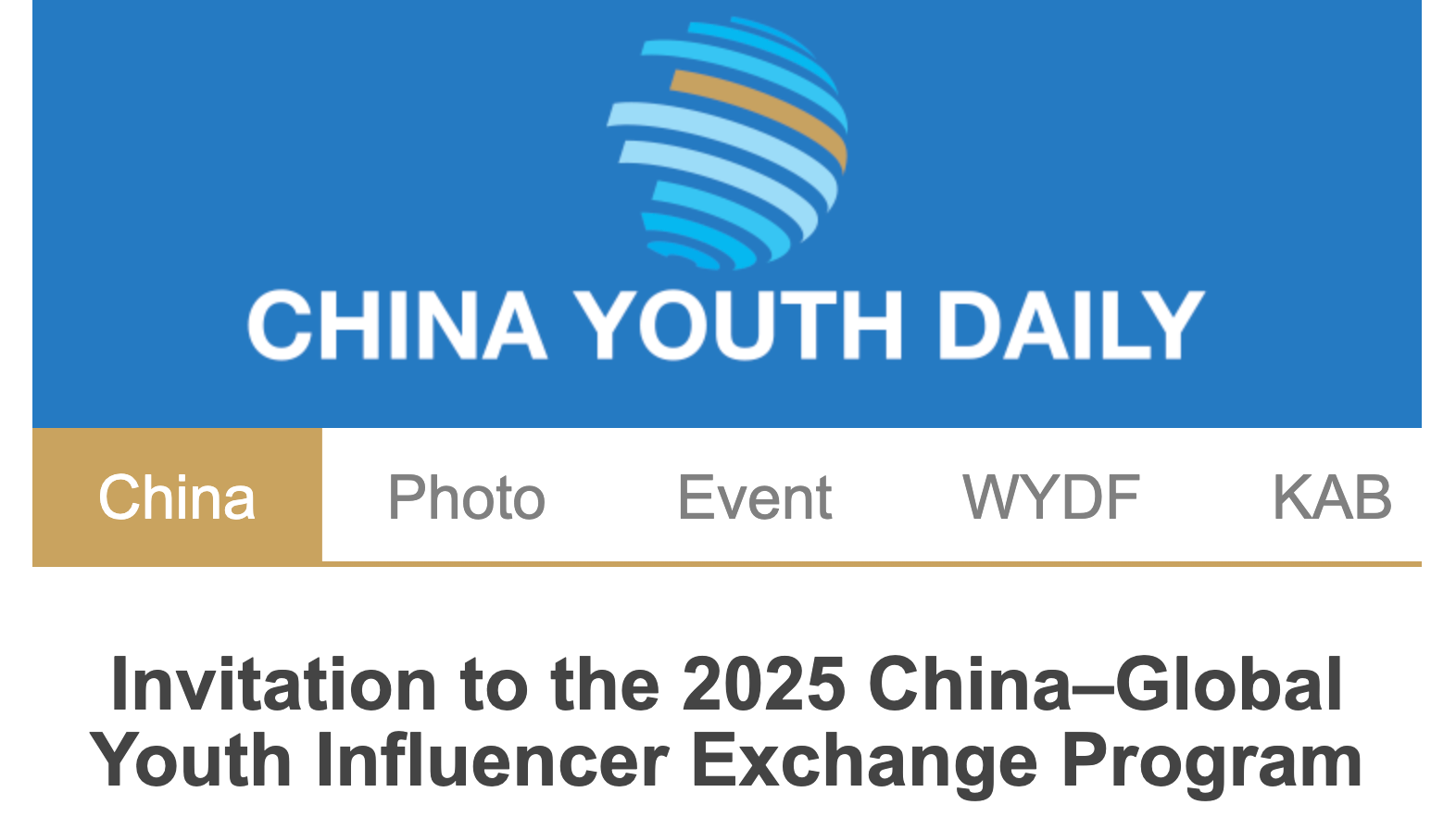
Throughout the year, specific trips came to light, with varying levels of explicit Chinese state-backing: In March and April, livestreamer Darren Watkins, known online as ‘IShowSpeed,’ traveled to China and collaborated with China-based creators, garnering hundreds of millions of views. In September, four prominent Kenyan influencers and comedians visited Hunan and Fujian at the Chinese embassy’s invitation, while Senegalese-Italian TikTok star Khaby Lame also toured multiple cities in China that month. Both visits were widely touted by the state-run China Daily. A January report by the Global Taiwan Institute also highlighted United Front-linked organizations recruiting Taiwanese influencers for “youth exchanges” on the mainland.
As with traditional media junkets, such trips could be seen as fair play. However, lack of transparency about funding, payments, or amplification by state media, troll networks, or platform algorithms risks veering into covert manipulation.
At a time when younger audiences shift away from platforms like X—where Chinese state media built large but low-engagement followings—co-opting influencers represents an effective tactic to shape a new generation’s views on China.
3. Expanding Global Footprint of China-Owned Online Platforms
TikTok, owned by ByteDance, remains the centerpiece of this phenomenon, reaching over 1.5 billion global monthly active users in 2025—an increase of at least 10 percent from 2024. This was driven largely by growth in Japan, as well as in emerging markets in Africa, the Middle East, and Latin America (especially Brazil and Mexico). In saturated regions like North America and Western Europe, user growth slowed, but time spent and engagement deepened.
Yet TikTok is not alone. Tencent’s WeChat app continues as a vital information hub for the Chinese diaspora, while lesser-known apps have extended their reach in Latin America, Africa, and Southeast Asia:
Kwai (the international version of Kuaishou), a short-video and livestreaming platform similar to TikTok, has gained prominence in Latin American countries, the Middle East, and parts of Southeast Asia, ranking #3 in Brazil and #7 globally among social media services, according to CloudFlare.
CapCut, also ByteDance-owned, has capitalized on TikTok’s success as a video-editing tool, and become one of the top 10 most downloaded mobile apps with hundreds of millions of monthly users.
Opera browser and Opera News is a web browser with built-in news, video, and content recommendations that is majority owned by Chinese tech firm Kunlun. It has become popular in Africa and South America for data-saving features and news feeds in local languages. It reportedly has at least 350 million active users and some analysts rank it as the fourth most used browser in the world.
These examples highlight the successes and innovation of platforms owned by China-based firms but also the risks for content manipulation and data collection. While some past complaints raised concerns about anti-democratic censorship on Opera News, these apps have faced far less scrutiny of their algorithms, moderation, and data practices than TikTok, WeChat, or DeepSeek.
4. Deepfakes and Anonymous Threats to Silence and Smear Dissidents
The CCP’s longstanding transnational repression toolkit—ranging from physical attacks and legal intimidation to online harassment and threats to family in China—expanded in 2025 with damaging tactics blending digital and real-world harm.
Deepfakes, sexual smears, death threats, and false impersonations targeted exiled activists, film screenings, and religious believers.
Notably, deepfakes and sexual smears targeted exiled activists, including Hong Kong pro-democracy figures facing politicized bounties and arrest warrants. In December, the Guardian reported sexually explicit letters and posters sent to addresses in the UK and Australia. Former neighbors of Carmen Lau, an exiled district councilor, received digitally faked images portraying her as a sex worker. Ted Hui, a former Hong Kong legislator in Australia, faced similar fake posters targeting his wife. Combined with the bounty offered by the Hong Kong police, these campaigns threaten targets’ safety, travel, and mental health.
Separately, anonymous hoaxes—including death threats, bomb threats, and impersonations—targeted Falun Gong practitioners, Shen Yun Performing Arts events, and screenings of documentaries on organ transplant abuses in China. The Falun Dafa Information Center and local media reports have documented dozens of cases across multiple countries in 2025. The threats—typically sent via emails or online contact forms—have not materialized as actual violence. Nevertheless, each time a threat comes in, it must be taken seriously by the target, the venue, and local law enforcement. This has resulted in building evacuations, increased security costs, canceled film screenings, and venue reluctance to book certain events.
In April, local authorities traced threats against Shen Yun in Taiwan to China, leaving the perpetrators beyond legal reach. With ongoing impunity, there is little reason for those behind the threats to desist, especially as the actions occasionally succeed where overt Chinese diplomatic pressure has failed.
5. Boost to Beijing from U.S. Withdrawal
No recap of 2025 developments related to Beijing’s foreign information influence would be complete without noting diminished global and American resilience due to severe U.S. funding cuts.
Congress’s late-2024 refusal to renew the mandate for the State Department’s Global Engagement Center (GEC), which tracked foreign influence (including PRC efforts) and supported civil society, began a decline that accelerated throughout 2025. Further reductions gutted programs for civil society at the State Department, National Endowment for Democracy, and USAID, followed by the shuttering of Voice of America and deep cutbacks at Radio Free Asia, U.S.-funded news outlets.
These cuts have affected a wide range of policy and issue areas. But they have also reversed years of progress in building democratic resilience against CCP propaganda, censorship, and manipulation. The reductions have undermined concrete and cost-effective independent research, investigative reporting, capacity building, and content dissemination vital for protecting free expression and undercutting Beijing’s ability to spread falsehoods, silence critics, and build latent networks of influence that can be activated in the future with far-reaching consequences. The cuts have also gutted critical resources used by U.S. policymakers themselves to inform decisions related to events in China and CCP infiltration abroad.
The implications of the U.S. retraction are broader than occasional anecdotes of China-linked entities moving in to offer funding to hamstrung organizations and news outlets. Even as other private and government funders from democracies offer support, there is a whole ecosystem of research, investigations, and information-sharing that has been devastated and will take years to rebuild when (or if) funding resumes. Unlike Beijing’s heavy-handed and covert information controls, that ecosystem was characterized by editorial independence, transparency, technological innovation, and intellectual curiosity. It was driven by a dedication to protect free expression and access to information, not crush them.
Closing Thoughts
As 2025 draws to a close, Beijing’s advancing information influence arsenal—powered by AI, global platforms, paid influencers, and a willingness to exploit violence and sexual innuendo—poses an acute challenge to global freedom of expression, democratic discourse, and national security. The U.S. government’s withdrawal has only amplified these risks, eroding hard-won safeguards against manipulation and intimidation. Without urgent action, the real-world impact of the CCP’s actions risks deepening, with profound implications far beyond Washington or Beijing.
This article was also published in the Diplomat on December 29, 2025.
This is a great recap of how influence operations are getting industrialized: AI-enabled influence + cyber, youth/influencer outreach, expansion of China-owned platforms, deepfakes/anonymity to smear or intimidate dissidents, and a tailwind from weaker Western countermeasures and funding cuts.
No Shots Fired tie-in: this is “winning” by shaping the operating environment instead of fighting a battle—normalize the narrative, raise the personal cost of dissent, keep attribution muddy, and let targets bleed time and resources responding.
Hi, thanks for the news, PS - it is now The CPC not CCP.